CAL/OSHA PUBLISHES UPDATED VERSION OF DRAFT WORKPLACE VIOLENCE PREVENTION STANDARD

For the past year, nearly all California employers have been required to comply with the State’s workplace violence prevention law (Labor Code Section 6401.9), which became effective on July 1, 2024. Section 6401.9 requires, among other things, that employers implement a written workplace violence prevention plan (“WVPP”), train employees on the WVPP and workplace violence hazards, maintain a violent incident log and other workplace violence-related records, and conduct periodic reviews of the WVPP. Section 6401.9 also instructed California’s Division of Occupational Safety and Health (“Cal/OSHA”) to propose a general industry workplace violence prevention standard by December 1, 2025 and gave Cal/OSHA’s Standards Board until December 31, 2026 to adopt the standard. On May 13, 2025, Cal/OSHA published an updated draft of its standard and requested additional public comments by July 14, 2025.

1. Background On Cal/OSHA’s Draft Standard

On July 15, 2024, Cal/OSHA published its initial draft standard and requested public comments on the draft by September 3, 2024. The initial draft contained numerous revisions to the language in Section 6401.9. On January 24, 2025, Cal/OSHA held an advisory meeting to consider the changes to Section 6401.9 in the initial draft. In the updated draft published by Cal/OSHA on May 13, 2025, Cal/OSHA revised much of the language added in the initial draft and made further additions, all of which appear to stem from the public comments and advisory committee meeting feedback. Cal/OSHA will hold an advisory committee meeting on the updated draft later this year.

2. Summary Of Key Proposed Revisions

The updated draft standard contains numerous key revisions to the current law, including the following:

Exemption Clarifications: Section 6401.9 exempts a very limited number of employers and places of employment, including those that are not accessible to the public and have less than 10 employees working at any given time. However, the updated draft standard clarifies that only employers with a total headcount of “less than a total of 10 employees” are exempt. The updated draft further states that this exception does not apply to security services, janitorial services, and domestic workers at those workplaces. In other words, the standard applies to security services, janitorial services, and domestic workers who work in places of employment that are not accessible to the public and where there are less than 10 employees.

“Threat Of Violence” Definition Clarification: The updated draft standard clarifies under the definition of a “threat of violence” that the employer is not responsible for an “employee’s texts, electronic messages, or personal social media that are not brought to the attention of the employer or that the employer could not otherwise be reasonably be aware of.” The updated draft standard also clarifies that the term “workplace violence” includes the crime of stalking (as defined in California Penal Code 646.9) which occurs at a place of employment, or in connection with a place of employment that is brought to the attention of the employer or that the employer could otherwise be reasonably be aware of.

“Engineering Controls” Definition Clarification: The initial draft standard identified various engineering controls for employers to implement, such as electronic/mechanical access to employee-only areas, weapons detectors, enclosed workstations with shatter-resistant glass, and furniture affixed to the floor. The updated draft clarifies that the controls listed are not required. Rather, they are examples and should be implemented where applicable.

“Work Practice Controls” Definition Clarification: The initial draft standard also identified various work practice controls for employers to adopt, such as appropriate staffing levels, dedicated security personnel, and methods and procedures to prevent unauthorized firearms and weapons in the workplace. The updated draft also clarifies that the controls listed are not required and constitute examples for employers to implement where applicable.

“Workplace Violence Hazards” Definition Addition: The updated draft standard includes a new “workplace violence hazards” definition that lists examples of working conditions that may increase the risk of an incident, such as areas with poor illumination or blocked visibility of surrounding areas, “work locations, areas, or operations that lack effective escape routes,” “frequent or regular contact with the public,” “entries to places of employment where unauthorized access can occur.” The list also includes subjective conditions, such as “hostile work environments,” “required and excessive overtime,” and “inadequate staffing.” This added definition likely will be the subject of many public comments.

“Authorized Employee Representative” Definition Addition: The updated draft standard includes a new “authorized employee representative” definition, which applies only to this standard and means “an organization that has a collective bargaining relationship with an employer or an organization acknowledged by a public agency as representing its employees.” Presumably, this means an employee’s counsel does not qualify as an “authorized employee representative.”

Removal Of Language Banning Criminal Confrontations: The initial draft standard contained language prohibiting employers from requiring or encouraging employees (other than dedicated security personnel) to confront persons suspected of committing a criminal act or persons suspected of engaging in workplace violence. The updated draft removed that language entirely and replaced it with language prohibiting employers from retaliating against an employee “involved in a lawful act of self-defense or defense of others.”

Removal Of Additional Language: The updated draft standard removed certain language that Cal/OSHA added in the initial draft, including (1) a requirement for employers to allow employees to remove themselves from any unsafe condition when necessary and without fear of reprisal, and (2) a requirement that employers must keep a record of corrective measures considered or implemented to address workplace violence hazards.

Employee Reporting: The updated draft standard includes a provision that requires employers to ensure that employees can report “type 3” workplace violence (i.e., violence by an employee against another employee, supervisor, or manager) to someone who is not the reporting employee’s direct supervisor.

Record Retention Clarification: The updated draft standard clarifies that all workplace violence-related records required under Section 6401.9 must be kept for five years, except for training records, which must be kept for at least one year.

3. Practical Considerations

It is likely that the updated draft standard will undergo further edits before Cal/OSHA publishes its final standard for the Standards Board to adopt. In the meantime, the current requirements under Section 6401.9 will remain in effect, and employers should ensure they continue to comply with those requirements. Notably, Section 6401.9 currently requires compliance with the following obligations on an annual basis: (1) conduct workplace violence prevention training for employees, and (2) review the effectiveness of the WVPP and revise as needed. Employers who completed an initial workplace violence prevention training in the summer of 2024, but have not done a subsequent training for current employees, should do so as soon as possible. Likewise, employers who have not reviewed their WVPP since rolling it out last summer should ensure they review it again to determine if any changes are necessary. Employers with any questions or concerns about compliance should consult with experienced employment law counsel.

For more information and guidance on developing and implementing a workplace violence prevention plan, please refer to the Employer’s Guide to Workplace Violence Prevention by Sheppard Mullin Attorneys Richard J. Simmons and Robert K. Foster. The publication is now available from Castle Publications.

To read more articles like this one, subscribe to the ALERT Newsletter today!


About The Author

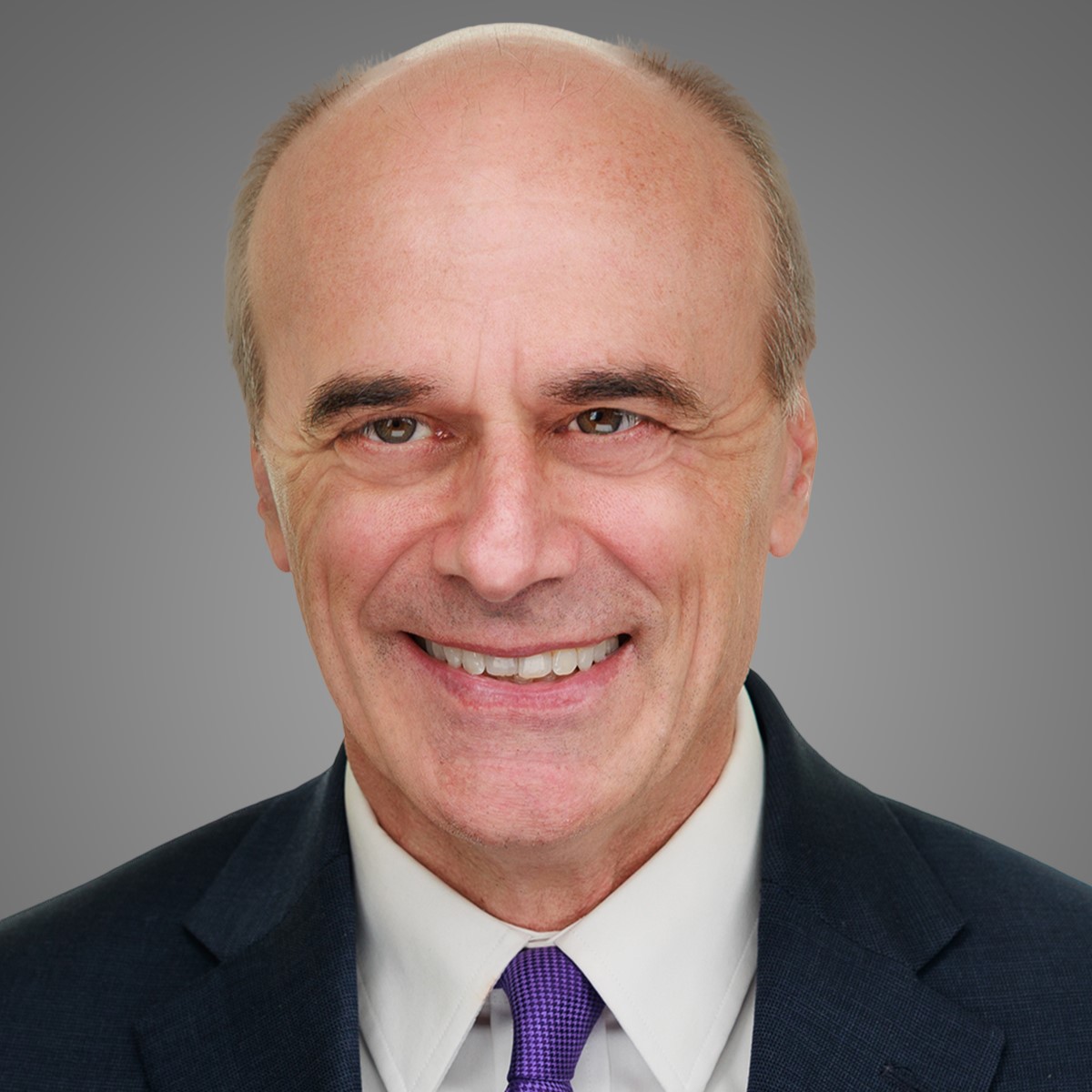
Robert K. Foster is an Associate with Sheppard, Mullin, Richter & Hampton LLP in the firm’s San Diego (Del Mar) Office. Mr. Foster represents employers in various types of employment litigation, including class action wage and hour claims; PAGA claims; and discrimination, wrongful termination, harassment and retaliation lawsuits. In addition, he also provides strategic advice to employers on a wide range of employment issues, including wage and hour compliance, employee classification, and OSHA matters. He is a frequent contributor to the California Labor and Employment ALERT Newsletter and several other articles and is the co-author of the Employer’s Guide to Workplace Violence Prevention.

Robert litigates actions involving trade secret claims, unfair competition and enforcement of restrictive covenants and non-competes. He also handles various commercial litigation disputes, including breach of contract, breach of fiduciary duty, fraud, tortious interference with contract, unfair competition and shareholder derivative claims.

WHAT EMPLOYERS SHOULD KNOW ABOUT RESPONDING TO ICE ENFORCEMENT ACTIONS

With the Trump Administration’s renewed focus on immigration, many companies are asking what to expect, and how to respond to a potential raid on their facilities by Immigration and Customs Enforcement (“ICE”). As enforcement activities continue to unfold, employers should take proactive steps to prepare for possible ICE visits or audits.

ICE is charged with the arrest, detention and removal of certain non-citizens. Most employers are already aware that ICE conducts occasional I-9 audits. But the new administration signals an increased likelihood of ICE visiting worksites to arrest non-citizens who are subject to removal from the U.S. These actions are typically based on a civil administrative warrant, although occasionally they arise from a judicial criminal warrant. Most likely though, the Enforcement & Removal Operations (“ERO”) division of ICE will focus on non-citizens with serious criminal convictions and those who were ordered removed by an Immigration Judge but have failed to depart the U.S.

Additionally, we anticipate an increase in I-9 audits in the coming years. However, due to limited agency resources and the likely economic impact, we do not expect mass raids. While some I-9 audits will be randomly selected, others will be based on a broader investigation that ICE may be conducting of that company.

Below is some guidance to prepare employers for possible ICE visits or audits.

1. ICE Priorities

The Enforcement & Removal Operations division of ICE has announced that it will target non-citizens with serious criminal convictions and those who were ordered removed by an Immigration Judge but failed to depart the U.S.

2. Civil Arrests With An Administrative Warrant From ICE

Most immigration status violations are a civil matter, not criminal. ICE has authority to issue civil administrative warrants to take custody of individuals that it has probable cause to believe are removable from the U.S. These are signed by ICE immigration officers.

3. Federal Criminal Arrests With A Warrant From A Federal Judge

Individuals are subject to criminal arrest by ICE if they have:

• Been ordered removed but never departed the U.S.;

• Re-entered the U.S. after being removed;

• Used false documents to obtain employment in the U.S.;

• Knowingly hired an individual who is not work authorized (this is reserved for a pattern/practice);

• Retained an employee after ICE informed the employer that the employee is not work authorized; or

• Any federal crime that happens to come under the jurisdiction of ICE.

4. ICE Raids

As discussed further below, we do not anticipate many mass raids by ICE. Rather, ERO will conduct targeted enforcement actions. This is because of a number of reasons.

a. Resources And Logistics: ICE has a limited number of agents, detention space, airplanes, and funds with which to conduct removal operations. In addition, almost all individuals who are arrested by ICE are entitled to a hearing before an Immigration Judge before they can be removed. Therefore, ICE has to conduct targeted operations, not mass raids.

b. Private Property: ICE may not enter private property including the private portions of commercial establishments without permission, absent the rare circumstance where there is a criminal warrant issued by a Judge.

c. Hospitals: Even though it has recently reversed a policy prohibiting this, it is very unlikely that ICE will enter a hospital to make a civil administrative arrest. ICE understands that patients are undergoing medical treatment and the agents do not want to take custody of a patient who requires medical treatment. Moreover, hospitals understandably will not release confidential data due to HIPPA requirements.

d. Schools And Churches: Unless a school or church has a pattern and practice of promoting illegal immigration and/or harboring large numbers of migrants from ICE, it is highly unlikely ICE will enter these facilities.

e. Homes: With civil administrative warrants, absent exigent circumstances, ICE must knock on the door and cannot enter without permission. However, if there is no cooperation, ICE will consider asking a Judge for a criminal arrest warrant if there are grounds to do so. In addition, if ICE encounters challenges to completing the arrest, they may be more likely to want to arrest other non-citizens in the home that lack legal status in the U.S.

5. Right To Remain Silent

Individuals, including non-citizens, may invoke their right to remain silent when questioned by ICE. Any statements they make may be used against them. That said, employers may choose to cooperate with ICE so as to avoid complications with the agency. Consult with legal counsel prior to admitting any liability.

6. ICE Request For Immigration Papers

When in public, immigration officers may ask a non-citizen for their immigration papers. The non-citizen is required to have such papers with them and to provide them to the officer. Failure to do so can lead to a $100 fine and/or up to 30 days in jail.

7. Data Analytics

To assist in their investigations, ICE has access to a host of data including state and federal arrests and convictions, employer quarterly federal payroll reports, Social Security information, U.S. passport databases, lawful permanent resident (green card) databases, Employment Authorization Document (“EAD,” or work permit) databases, I-94 databases and birth certificate information from some states.

8. I-9 Notice Of Inspection vs. I-9 Raid

Most I-9 audits involve Homeland Security Investigations (“HSI”, a different division of ICE from ERO), which drops off a Notice of Inspection and then collects the company’s I-9’s. In some states, like California, once a federal I-9 audit has commenced, the state requires that the employer post the Notice of Inspection and notify any union. An employer is liable for missing I-9’s or I-9’s that have substantive errors. However, they are not liable if an employee’s documents looked real at the time of hire but turn out to be fake. Toward the end of the audit, if ICE finds missing or false papers, it traditionally has issued a Notice of Suspect Documents advising the employer to terminate individuals on that list. However, going forward it’s possible ICE may sometimes bypass issuing the Notice of Suspect Documents and simply arrive at the worksite with civil warrants for the arrest of those employees. However, we believe this will not be the norm, due to limited agency resources.

9. Cooperation With ICE

While an employer does not have to cooperate with a civil administrative warrant, there is a risk that the agency could commence an I-9 audit if they felt an employer was obstructing their need to arrest a non-citizen employee, or in some cases obtain a criminal warrant from a Judge if they feel the conduct supports it.

10. Avoid Discrimination In Hiring

Do not ask an applicant for employment about their immigration status. You may ask if they require visa sponsorship to work for you now or in the future. After a job offer has been extended, you may give them an I-9 form to complete, in order to confirm that they are authorized to work. If you are not sure if someone is work authorized, consult with counsel. Denying employment when someone is work authorized can create substantial liability for the company.

11. Navigating The Maze

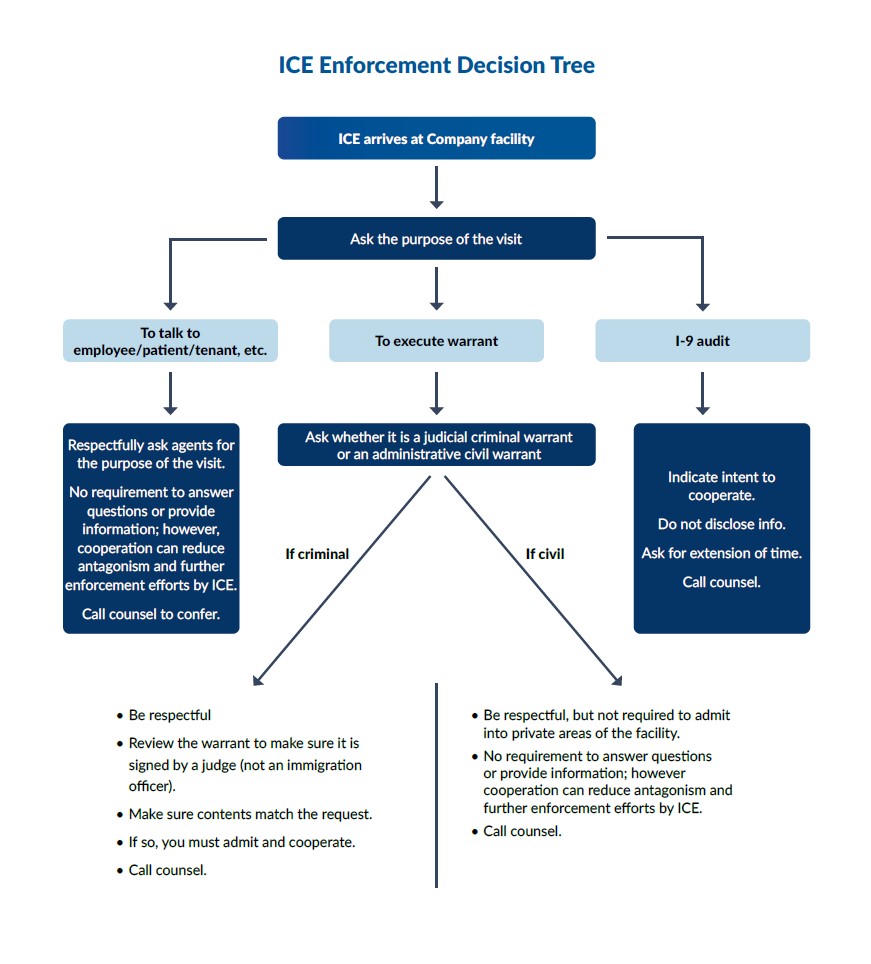
Please find a decision tree below which may be used if immigration officers visit your facility. This diagram is for general informational purposes and should not be construed as individual legal advice. Always consult legal counsel to ensure compliance and avoid liability.

To read more articles like this one, subscribe to the ALERT Newsletter today!


About The Authors

Greg L. Berk is a Partner in the law firm of Sheppard, Mullin, Richter & Hampton LLP in the firm’s Orange County office. He leads the Firm’s immigration practice and is a Certified Specialist in Immigration and Nationality Law by the State Bar of California Board of Legal Specialization>. He has over 25 years of experience advising on all aspects of U.S. immigration matters. He assists employers worldwide with the hiring and retention of foreign national executives and highly talented individuals that are needed in their U.S. workforce. He also works with investors on E-2, L-1, and EB-5 matters. He also handles I-9 and other immigration compliance matters.

Greg frequently lectures on immigration issues and is a regular contributor to the California Labor and Employment ALERT Newsletter and Sheppard Mullin’s Labor & Employment Law blog. Mr. Berk received his J.D. from Western State University College of Law, his M.B.A. from George Washington University and his B.A. from California State University.

Jonathan Meyer is a Partner in the Governmental Practice Group with the law firm of Sheppard, Mullin, Richter & Hampton LLP in the firm’s Washington DC offices. He counsels clients on their interactions with federal and state government, as well as national and homeland security, Congressional oversight, cybersecurity, AI, high tech, and transportation security, among other issues.

Prior to returning to Sheppard Mullin, Jon was nominated by President Biden and confirmed by the Senate as the Sixth General Counsel of the U.S. Department of Homeland Security, serving from 2021 to 2024.

Jon is regularly sought out by the media – including CBS News, NPR, The Wall Street Journal, The New York Times, The Washington Post and Politico – on issues including national security, homeland security, government investigations, cybersecurity, immigration, politics and Congress.

EMPLOYMENT STATUS OF MANY FEDERAL EMPLOYEES STILL UNCLEAR

Employment for thousands of federal employees remains in limbo as courts respond to layoffs initiated by the Trump Administration under the auspice of maximizing governmental efficiency and productivity. Recently, both the U.S. Supreme Court and the U.S. Court of Appeals for the Fourth Circuit intervened in separate actions to pause federal court orders mandating the reinstatement of tens of thousands of probationary federal workers. At the same time, the U.S. Court of Appeals for the Ninth Circuit in a different lawsuit denied an emergency motion seeking to stay a preliminary injunction preventing the termination of these same federal workers. This ongoing litigation not only continues to raise important questions about the Executive Branch’s authority to restructure the vast federal bureaucracy, but also calls into question the scope of judicial review.

1. The Mass Firing Of Government Employees

The legal battles began on February 13, 2025, when the Office of Personnel Management (“OPM”) issued a directive as part of President Trump’s broader effort to streamline federal operations. This directive led to the termination of tens of thousands of federal employees, a move the Trump Administration justified as necessary to dramatically improve workforce efficiency. Probationary employees, typically those in the first year or two of their federal employment, were disproportionately impacted by the OPM’s directive.

Various non-profits and advocacy groups challenged this directive, including the American Federation of Government Employees and the American Federation of State, County, and Municipal Employees. These groups argued the OPM exceeded its statutory authority under the Administrative Procedure Act by directing terminations across multiple federal agencies without congressional approval. They further argued that the substantial loss of federal employees would adversely affect the services they rely on and harm their workers.

2. First Preliminary Injunction In The Northern District Of California And Supreme Court Intervention

The legal challenge gained significant momentum when Judge William Alsup of the U.S. District Court for the Northern District of California issued a preliminary injunction on March 13, 2025. Basing his decision only on the challengers’ arguments, Judge Alsup concluded that the OPM’s actions were “ultra vires,” meaning beyond its legal authority, as the power to hire and fire federal employees is vested in individual agencies, not the OPM. In his detailed ruling, Judge Alsup emphasized that the mass terminations were orchestrated without proper authorization and violated statutory requirements. The injunction mandated the immediate reinstatement of roughly 16,000 employees from the Departments of Agriculture, Defense, Energy, Interior, Treasury, and Veterans Affairs.

On April 8, 2025, the U.S. Supreme Court intervened, granting an emergency application filed by the OPM to stay Judge Alsup’s order. In a 7-2 vote, the Justices agreed the nine non-profit organizations challenging the terminations lacked standing—a legal right to sue—thereby halting the reinstatement process. Providing little explanation, the unsigned order stated, “[t]he District Court’s injunction was based solely on the allegations of the nine non-profit-organization plaintiffs in this case. But under established law, those allegations are presently insufficient to support the organizations’ standing.”

Justices Sonia Sotomayor and Ketanji Brown Jackson dissented, arguing that the standing issue should not have been addressed at this stage.

3. Second Preliminary Injunction In The Northern District Of California

On May 9, 2025, in a separate lawsuit filed in the U.S. District Court for the Northern District of California brought by a similar coalition of non-profits and advocacy groups, Judge Susan Illston issued a preliminary injunction blocking the enforcement of the executive order directing federal agencies to initiate large-scale layoffs and reorganizations. The court determined the coalition of unions, nonprofits, and cities challenging the order showed a strong likelihood of success, particularly because such extensive federal reorganization requires explicit congressional approval. Judge Illston explained Congress holds the authority to create, fund, and define federal agencies, and the President and OPM cannot unilaterally impose widespread layoffs in violation of separation of powers principles.

In response, the Trump Administration immediately moved for a stay by seeking emergency relief from the U.S. Court of Appeals for the Ninth Circuit. The administration argued the injunction encroached on the President’s Article II authority over Executive Branch personnel and the efforts to reorganize and streamline federal government operations. In a 2-1 decision, a panel of the U.S. Court of Appeals for the Ninth Circuit denied the request for a stay on May 31, 2025. The panel concluded the government failed to show irreparable injury from the preliminary injunction and had not demonstrated a strong likelihood of success on the merits.

The government subsequently filed an emergency application with the U.S. Supreme Court on June 2, 2025, requesting intervention. The U.S. Supreme Court has requested the coalition of non-profits, advocacy groups, and cities respond to the emergency application by June 9, 2025, before it issues a ruling.

4. Ongoing Legal Battles In The Fourth Circuit

While battles continue in the Ninth Circuit, a separate battle has been ongoing in the Fourth Circuit. On March 13, 2025, Judge James K. Bredar of the U.S. District Court for the District of Maryland sided with a number of agencies and states that challenged the OPM’s directive and held that the mass terminations violated federal reduction-in-force statutes. Judge Bredar ordered the reinstatement of employees across 20 federal agencies. This order applied to a broader range of agencies in 19 states and the District of Colombia.

However, on April 2, 2025, the U.S. Court of Appeals for the Fourth Circuit granted the Trump Administration’s request to stay Judge Bredar’s order, ruling the U.S. District Court for the District of Maryland likely lacked jurisdiction.

5. Where Things Stand Now

The employment status of thousands of federal workers remains uncertain after a series of legal and political challenges. The U.S. Supreme Court’s intervention provided temporary relief to the Trump Administration, allowing it to avoid the reinstatement of federal employees while litigation unfolds. Subsequently, the U.S. Court of Appeals for the Ninth Circuit confirmed an injunction preventing the termination of these same federal employees pending further litigation. Meanwhile, litigation in the Fourth Circuit is ongoing regarding the scope of reinstatement ordered by the U.S. District Court for the District of Maryland. As a result, federal employees whose jobs were affected by the mass terminations remain in a state of limbo.

To read more articles like this one, subscribe to the ALERT Newsletter today!


About The Author

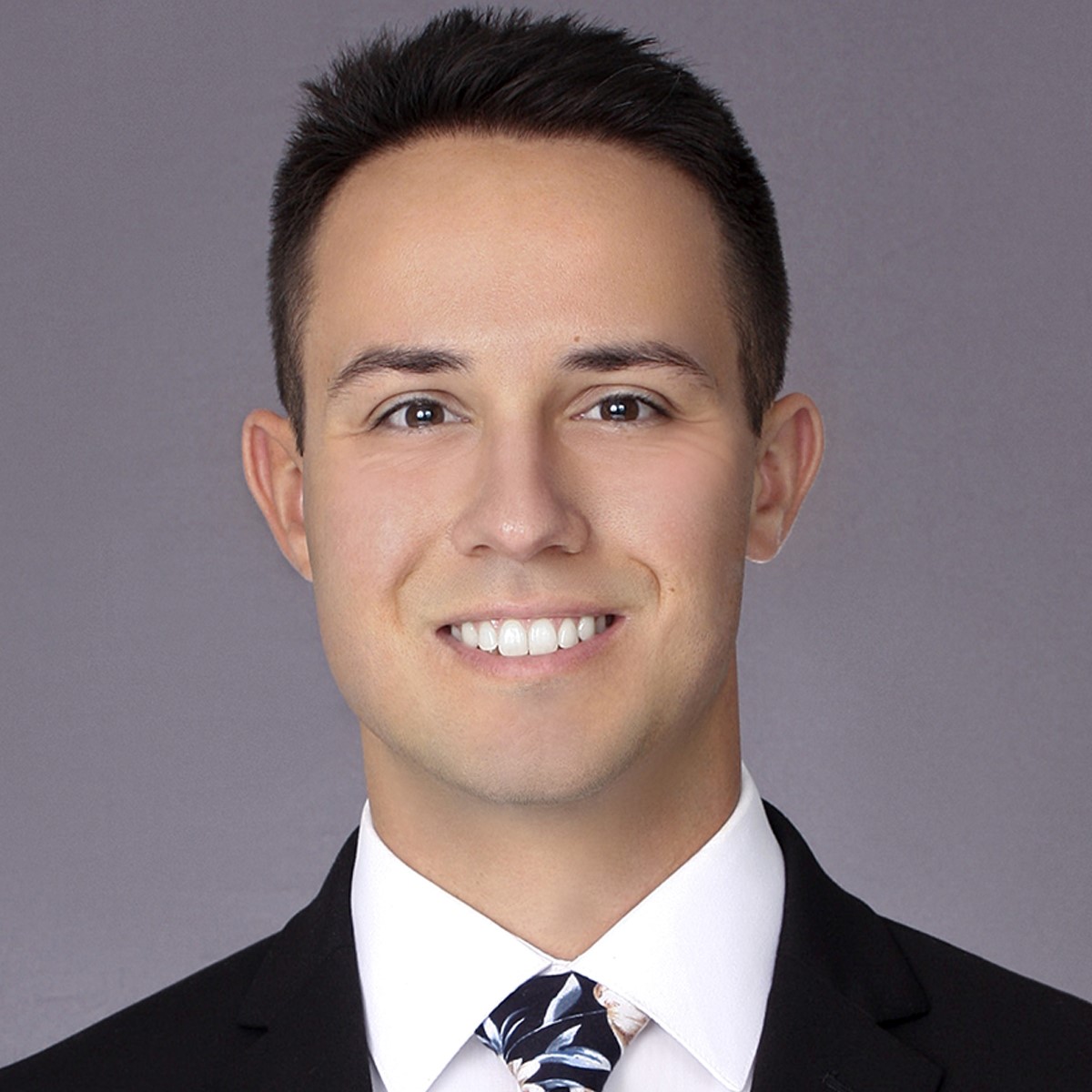
Luke Bickel is an attorney in Sheppard Mullin’s Labor and Employment Practice Group in the firm’s San Diego (Del Mar) office. Mr. Bickel defends employers of all sizes in matters involving discrimination, retaliation, harassment, wrongful termination, and wage and hour. He has experience defending all aspects of employment-related claims, from single plaintiff to class and PAGA matters, in state and federal court. Beyond the realm of litigation, Luke advises clients on employment issues ranging from wage and hour compliance to federal OSHA and Cal/OSHA investigations. Luke’s experience also includes helping clients obtain workplace violence restraining orders and conducting workplace investigations.

Luke is a consistent contributor to Sheppard Mullin’s Labor & Employment Law Blog, Trade Secrets Law Blog, and the California Labor and Employment ALERT.

Mr. Bickel received his law degree from the USC Gould School of Law and his undergraduate degrees from Cal Poly State University, San Luis Obispo, magna cum laude.

CALIFORNIA FINALIZES AI HIRING REGULATIONS: WHAT EMPLOYERS NEED TO KNOW

On March 21, 2025, the California Civil Rights Council adopted final regulations governing the use of artificial intelligence and automated decision systems in employment decisions. These regulations, pending approval by the Office of Administrative Law, are expected to take effect on July 1, 2025.

1. Background

The new regulations apply to any automated system—such as AI tools, algorithms, or machine learning models—that helps make employment decisions. These regulations will prohibit discriminatory use of these tools and impose obligations around selection practices, accommodation, and recordkeeping. Unless these regulations are preempted by pending federal legislation, employers, staffing agencies, and vendors using such systems in California will need to comply once the rules take effect.

2. Key Provisions

The regulations adopt a broad definition of automated-decision system (“ADS”), covering any computational process—including those using artificial intelligence, algorithms, machine learning, or statistical modeling—that is used to make or support decisions or evaluations related to employment benefits. Examples include tools used to screen resumes, evaluate interviews, assess traits or characteristics of job applicants, or targeted job advertisements. The definition excludes passive tools like spellcheckers, formatting tools, or similar general-use technologies unless they actively affect employment outcomes.

The regulations make it unlawful to use an ADS or any selection criteria—including employment tests, qualification standards, or proxies—that results in discrimination against applicants or employees based on protected characteristics. This includes both disparate treatment (i.e., when an employer intentionally treats applicants and employees differently based on a protected class) and disparate impact (i.e., when an otherwise neutral policy or practice results in a discriminatory outcome). The presence or absence of anti-bias testing or similar safeguards is expressly relevant in determining whether an unlawful practice has occurred and whether any available defense (such as business necessity) applies.

The regulations also address certain pre-employment practices. Employers may not use ADS that elicit or rely on information about protected characteristics unless justified by a lawful defense. For example, if a scheduling-based screening tool excludes applicants due to availability, the employer may need to provide a mechanism for individuals to request reasonable accommodation based on a disability or religious need. The same applies to systems that analyze voice, facial movements, or behavioral characteristics that may correlate with disability, religion, or other protected factors.

Employers are required to retain records related to the use of ADS. This includes all applications, personnel records, employment referral records, membership records, selection criteria, and all ADS-related data—such as inputs, outputs, and any information dealing with employment practices or employment benefits. These records must be preserved for at least four years from the date of the relevant employment action or record creation. If a complaint is filed, the obligation continues until the matter is resolved.

3. Practical Considerations

California employers should act now to assess their use of AI and automated tools in hiring and employment decisions. This starts with identifying any systems—whether in-house or provided by a third party—that meet the regulations’ broad definition of an automated-decision system. Employers should then evaluate whether those systems could result in disparate treatment or adverse impact based on protected characteristics, and document any business necessity justifications.

Where ADS is in use, employers should review whether the system could screen out applicants based on protected characteristics, and ensure that a process exists for individuals to request reasonable accommodation. Notices regarding the use of ADS are not explicitly required in the regulation text, but transparency and accessibility are emphasized in several contexts, particularly where accommodations may be necessary.

Additionally, employers should ensure they are retaining all records related to ADS use—including inputs, outputs, evaluations, and related documentation—for at least four years. These recordkeeping obligations apply regardless of whether the employer is the developer of the system or merely its user. By taking these steps proactively, employers can reduce legal risk and help ensure fair, compliant use of hiring technologies in California.

Finally, on May 22, 2025, the U.S. House of Representatives narrowly passed the “One Big Beautiful Bill Act” which as of early June 2025, is being considered by the U.S. Senate. The proposed legislation includes a near total ban on states enacting or enforcing AI-related legislation for 10 years. In the event Congress enacts, and President Trump signs, legislation barring state regulations over AI, such federal laws will likely have a significant impact on California’s proposed regulations.

To read more articles like this one, subscribe to the ALERT Newsletter today!


About The Author

Ryan J. Krueger is a Partner with Sheppard, Mullin, Richter & Hampton LLP in the firm’s Los Angeles office. He specializes in labor and employment matters on behalf of employers, including wage and hour violations, employment discrimination, wrongful termination and sexual harassment. Mr. Krueger has experience in all aspects of employment litigation, including brief writing and oral argument, taking and defending depositions, and negotiating settlements. He has also second chaired multiple trials and arbitrations, and argued before the California Court of Appeal. Mr. Krueger also regularly counsels employers regarding California and federal employment law issues.

Ryan is a co-author of the California’s Private Attorneys General Act (PAGA) Litigation and Compliance Manual, and is a frequent contributor to the California Labor and Employment ALERT Newsletter. He is a co-speaker at the Castle Publications’ Seminars as well as the Labor Law Update for Sheppard Mullin.

He received his J.D. from the University of California, Los Angeles and his B.A. from the University of Wisconsin, with distinction. During law school, Mr. Krueger served as extern to the Honorable Morton Denlow, U.S. District Court for the Northern District of Illinois. He is admitted to practice in all California state courts, along with the United States District Court for the Central District of California and the Ninth Circuit Court of Appeals.

LEGAL CHALLENGES MOUNT AGAINST TRUMP’S EXECUTIVE ORDERS ON DEI PROGRAMS

In January 2025, President Trump issued a series of executive orders aimed at dismantling Diversity, Equity, and Inclusion (“DEI”) programs within the federal government and among federal contractors. These actions have sparked significant legal challenges, raising questions about executive authority, constitutional protections, and the future of DEI initiatives in the United States.

1. Executive Orders Issued

a. Executive Order 14151: Titled “Ending Radical and Wasteful Government DEI Programs and Preferencing,” this order mandates the termination of all DEI and DEIA (Diversity, Equity, Inclusion, and Accessibility) programs within federal agencies. It also prohibits federal contractors from implementing DEI initiatives, asserting that such programs violate federal civil rights laws.

b. Executive Order 14173: Known as “Ending Illegal Discrimination and Restoring Merit-Based Opportunity,” this order revokes previous directives that required federal contractors to adopt affirmative action plans promoting diversity.

2. District Of Maryland Issues Nationwide Injunction

On February 21, 2025, the U.S. District Court for the District of Maryland issued a preliminary injunction halting the enforcement of certain provisions of the executive orders. This injunction came in response to a lawsuit filed by federal employees who contend that the orders improperly targeted DEI-related training and programs, which they argued were essential for creating inclusive, non-discriminatory work environments. They also asserted that the orders violated their free speech rights, as these programs often involved the free exchange of ideas on race, sex, and other social justice issues.

The District Court judge found that the plaintiffs had raised serious legal questions, particularly regarding the vagueness of the executive orders’ language on “divisive concepts.” The judge ruled that the broad scope of the orders could result in the suppression of protected speech and disproportionately affect minority employees, particularly those in historically marginalized groups. As a result, the judge granted the injunction, temporarily blocking the orders’ enforcement while the case moved forward in court.

3. Fourth Circuit Court Of Appeals Ruling

On March 14, 2025, the Fourth Circuit Court of Appeals lifted the nationwide injunction that had been previously granted by the Maryland District Court. This ruling effectively allowed the Trump Administration’s anti-DEI executive orders to be enforced while legal challenges continued.

The Fourth Circuit determined that the Trump Administration had likely acted within its authority to issue the executive orders, citing the president’s broad powers over federal agencies and contractors. The court concluded that the plaintiffs had not demonstrated sufficient harm to justify a nationwide block on the orders, which had been issued as part of the president’s effort to curb federal spending on DEI programs.

While the ruling allowed the executive orders to proceed, it did not definitively resolve the underlying constitutional issues. The case is expected to continue its way through the legal system, with further challenges likely to be heard by the U.S. Supreme Court in the coming months.

4. EEOC Issues Guidance

Most recently, on March 19, 2025, the Equal Employment Opportunity Commission (“EEOC”) issued new guidance regarding the DEI executive orders. The guidance emphasized that while the executive orders aimed to restrict certain DEI programs, they did not outright ban all diversity-related activities. Specifically, the EEOC noted that programs focused on preventing discrimination and promoting equal opportunity—core principles under Title VII of the Civil Rights Act of 1964—would still be permissible, even under the new restrictions.

The EEOC set forth the steps for employees who wish to file a lawsuit arguing they were discriminated against through an employer’s use of DEI programs. The EEOC made clear that employers cannot use a protected characteristic, e.g., race, gender, etc. in making employment determinations, even if the protected characteristic is not the sole determinative factor.

The EEOC clarified that federal employers could still conduct training aimed at preventing workplace discrimination, as long as the content did not promote “divisive” concepts, as outlined in the executive orders. However, the EEOC did note that DEI training can create a hostile work environment if an employee can prove the training was discriminatory in some way.

The legal and practical landscape of the anti-DEI executive orders is rapidly and frequently changing. There are likely to be myriad challenges to the orders and there may be conflict between the judiciary and the executive branch.

To read more articles like this one, subscribe to the ALERT Newsletter today!


About The Author

Tyler J. Johnson is a Partner in Sheppard Mullin’s Labor and Employment Practice Group in the firm’s Los Angeles office. Mr. Johnson represents employers in every stage of the litigation process, from prelitigation disputes to class certification hearings and trials. He represents businesses of every size, and has extensive experience in the healthcare, agricultural, fashion, and temporary staffing industries. Tyler defends employers against claims of discrimination, harassment, and retaliation, and has prevailed at trial in a pregnancy discrimination case. Tyler also routinely represents businesses in complex litigation, including proposed class actions and representative actions under the Private Attorneys General Act. Tyler has defeated class certification in a number of cases and frequently obtains summary judgment for employers.

Tyler is a co-author of the Private Attorneys General Act (PAGA) Litigation and Compliance Manual as well as a contributing author of the ALERT Newsletter.

Mr. Johnson received his law degree from the Pepperdine Caruso School of Law and his undergraduate degree from University of Maryland.

CAL/OSHA’S COVID-19 PREVENTION NON-EMERGENCY STANDARDS HAVE LARGELY ENDED

As discussed in the January 2023 and March 2023 editions of the ALERT, the California Division of Occupational Safety and Health’s (“Cal/OSHA”) COVID-19 Prevention Non-Emergency Regulations (“Non-Emergency Standards”) became effective on February 3, 2023, with an expected sunset date of February 3, 2025. On February 4, 2025, Cal/OSHA issued a press release confirming that “most” of the requirements under the Non-Emergency Standards expired on February 3, 2025.

1. Employers Are No Longer Required To Document And Follow Certain COVID-19 Prevention Procedures

Under the Non-Emergency Standards, California employers were required to identify their COVID-19 procedures which address COVID-19 as a workplace hazard in either their written Injury and Illness Prevention Program (“IIPP”) or a separate standalone document, similar to the COVID-19 Prevention Program (“CPP”) required under Cal/OSHA’s COVID-19 Emergency Temporary Standards, which were in effect earlier during the pandemic. The Non-Emergency Standards also required employers to follow certain procedures for notifying “close contacts” of potential exposure and for responding to an “outbreak” of three or more COVID-19 cases within an exposed group over a 14-day period. With the sunset of the Non-Emergency Standards, these specific requirements have expired and are no longer required.

2. Remaining COVID-19 Related Obligations

Cal/OSHA’s press release notes that although there is no longer a specific set of COVID-19 prevention regulatory requirements, California employers must still:

• Maintain a safe and healthful place of employment as required by Labor Code Section 6400.

• Establish, implement, and maintain an effective IIPP as required by Title 8, California Code of Regulations, Section 3203.

• Identify, evaluate, and correct any unsafe or unhealthy conditions, work practices, or work procedures associated with COVID-19 if they identify COVID-19 as a workplace hazard at their place of employment.

In addition to the above, certain COVID-19 reporting and recordkeeping requirements under the Non-Emergency Standards remain in effect until February 3, 2026. Under these requirements, employers must:

• Keep a record of and track all COVID-19 cases with the employee’s name, contact information, occupation, location where the employee worked, the date of the last day at the workplace, and the date of the positive COVID-19 test and/or COVID-19 diagnosis. Notably, these records must be retained for an additional two years.

• Provide information on COVID-19 cases to the local health department with jurisdiction over the workplace, such as the CDPH, Cal/OSHA, and NIOSH, immediately upon request, and when required by law.

3. Practical Considerations

Employers with an IIPP containing specific COVID-19 related procedures should update their IIPP to eliminate any procedures that are no longer required. Similarly, employers with a standalone CPP are no longer required to maintain the CPP. That said, employers should ensure they continue to comply with the obligations outlined above, especially where COVID-19 is a workplace hazard.

To read more articles like this one, subscribe to the ALERT Newsletter today!


About The Author

Robert K. Foster is an Associate with Sheppard, Mullin, Richter & Hampton LLP in the firm’s San Diego (Del Mar) Office. Mr. Foster represents employers in various types of employment litigation, including class action wage and hour claims; PAGA claims; and discrimination, wrongful termination, harassment and retaliation lawsuits. In addition, he also provides strategic advice to employers on a wide range of employment issues, including wage and hour compliance, employee classification, and OSHA matters. He is a frequent contributor to the California Labor and Employment ALERT Newsletter and several other articles and is the co-author of the Employer’s Guide to Workplace Violence Prevention.

Robert litigates actions involving trade secret claims, unfair competition and enforcement of restrictive covenants and non-competes. He also handles various commercial litigation disputes, including breach of contract, breach of fiduciary duty, fraud, tortious interference with contract, unfair competition and shareholder derivative claims.

U.S. SUPREME COURT HOLDS EMPLOYERS MUST ESTABLISH FLSA EXEMPTIONS UNDER PREPONDERANCE-OF-EVIDENCE STANDARD

The federal Fair Labor Standard Act (“FLSA”) guarantees covered employees minimum wages and overtime pay. It also establishes a number of exemptions from the overtime pay requirements, including an exemption for outside salesmen who primarily work away from their employer’s place of business. The law places the burden on the employer to show that the exemption applies.

1. The Overtime Exemption Issue

The U.S. Supreme Court addressed the evidence standard applicable to FLSA exemptions on January 15, 2025. In E. M. D. Sales, Inc. v. Carrera, ___U.S.___ (2025), several sales representatives who manage inventory and take orders at grocery stores sued their employer, EMD, which distributes food products in the Washington D. C. area. The employees claimed they were unlawfully denied overtime pay. In response, the employer argued they were exempt outside salesmen and thus not entitled to overtime pay.

2. The Lower Court Decisions Applied The Clear And Convincing Evidence Standard

The federal district court found EMD liable for overtime because it did not prove by “clear and convincing evidence” that the sales representatives were outside salesmen. On appeal, EMD argued that the district court should have used the less stringentpreponderance-of-the-evidence” standard instead of the clear and convincing evidence standard. The Fourth Circuit Court of Appeals disagreed with EMD and affirmed the district court’s judgment.

3. The Supreme Court Disagreed

After agreeing to hear the case, the U.S. Supreme Court unanimously held that the predominance-of-the-evidence standard applies when an employer seeks to demonstrate that an employee is exempt from the minimum wage and overtime pay provisions of the FLSA. It reasoned that the FLSA was enacted in 1938, when the preponderance-of-the-evidence standard was the default in American civil litigation, and it remains so today. Where a statute, like the FLSA, does not specify a standard of proof for exemptions, courts typically apply the preponderance standard. The Supreme Court thus found the employees’ policy-laden arguments for a heightened standard unconvincing. It reversed the Fourth Circuit’s decision and returned the case to the court of appeals to determine whether the employees would fail to qualify as outside salesman even under a preponderance standard.

4. Practical Considerations

The Supreme Court’s E.M.D. Sales decision is extremely important. It reinforces the rule that employers bear the burden of establishing the application of minimum wage and overtime exemptions under the FLSA. It identifies the correct evidentiary standard that applies in cases where the outside salesman exemption is litigated. It follows that the preponderance-of-the-evidence standard will also apply in cases where other exemptions are litigated, e.g., for executive, administrative, and professional employees.

The exemptions are reviewed at length in Chapter 10 of the Wage and Hour Manual for California Employers by Attorney Richard J. Simmons of Sheppard Mullin. The discussion emphasized the governing legal standards and many differences between the California law and the FLSA standards. The Manual is available through Castle Publications, LLC.

To read more articles like this one, subscribe to the ALERT Newsletter today!


About The Author

Richard J. Simmons is a Partner in the law firm of Sheppard, Mullin, Richter & Hampton LLP in Los Angeles. He represents employers in various employment law matters involving litigation throughout the country and general advice regarding state and federal wage and hour laws, employment discrimination, wrongful discharge, employee discipline and termination, employee benefits, affirmative action, union representation proceedings, and arbitrations. Mr. Simmons received his B.A., summa cum laude, from the University of Massachusetts, where he was a Commonwealth Scholar and graduated in the Phi Kappa Phi Honor Society. He received his J.D. from Berkeley Law at the University of California at Berkeley where he was the Editor-in-Chief of the Industrial Relations Law Journal, now the Berkeley Journal of Employment and Labor Law.

Mr. Simmons argued the only case before the California Supreme Court that produced a victory for employers and business in 2018. He was recently recognized as the Labor and Employment Attorney of the Year by the Los Angeles Business Journal and was inducted into the Employment Lawyers Hall of Fame. He has lectured nationally on wage and hour, employment discrimination, wrongful termination, and other employment and labor relations matters. He is a member of the National Advisory Board to the Berkeley Journal of Employment and Labor Law, published by Berkeley Law at the University of California at Berkeley. He was also appointed by the California Industrial Welfare Commission as a member of three Minimum Wage Boards for the State of California.

INCREASE IN CALIFORNIA MINIMUM WAGE RESULTS IN MULTIPLE CHANGES TO STATE LAW THAT ARE MORE COMPLICATED THAN EVER

California employment laws are not only rigid, they are becoming increasingly complicated and tricky. While it was once simple to identify the state minimum wage governing virtually all employers, the California legislature has no regard for consistency, clarity, or uniformity.

1. California Now Has Many Different Minimum Wage Rates

Now, the minimum wage rules vary based on a variety of factors, such as an employer’s size, industry (such as the fast food and health care rules that differ from the generally applicable minimum wage rules), and the counties and cities where they operate businesses and employ workers. As examples, some health care and fast food workers are covered by minimum wage rules that differ from the rules applicable to other health care and restaurant employees, as well the general minimum wage standards in effect for all other industries. To complicate the analysis, dozens of cities and counties across the state have adopted minimum wage ordinances that differ from the state and federal rules. This has caused the California Department of Industrial Relations to state: “Effective January 1, 2025, the minimum wage is $16.50 per hour for all employers, not otherwise covered by a higher minimum wage specific to an industry or a locality.” Bottom line: The devil is in the details. It is no longer easy to identify, let alone figure out, the governing minimum wage for specific employees.

2. The General Minimum Wage Increased On January 1

In 2024, the generally applicable state minimum wage was $16.00 an hour. On January 1, 2025, the state minimum wage increased to $16.50 for most employers. Variations nevertheless exist in jurisdictions subject to local minimum wage rules, for some fast food industry employers covered by special rules, and for some health care industry employers. Some cities and counties’ ordinances enacted higher local minimum wage rates for 2025.

It should also be remembered that increases in the California’s state minimum wage (as distinguished from changes mandated by local ordinances) have a direct and immediate impact on nine other features of California law, including the minimum salary rules in the white-collar exemptions, the minimum hourly rate that union employees must be paid to qualify for a state overtime exemption, the minimum sums commissioned employees covered by Wage Orders 4 and 7 must receive to meet an overtime exemption, the split-shift premium rule, and meal and lodging credits, among other rules. The derivative consequences of minimum wage increases are explained in Section 6.4(b) of the Wage and Hour Manual for California Employers (27th Edition), by Attorney Richard J. Simmons of Sheppard, Mullin, Richter & Hampton.

3. California’s Minimum Salary Level Increased For Exempt Employees

One of the most significant rules that automatically change whenever the state minimum wage increases involves the “salary level” requirements applicable to exempt executive, administrative and professional employees based on Labor Code Section 515. Because the statute establishes a minimum salary requirement that is a product of 80 times the state minimum wage, the minimum salary was $1,280 a week ($16 x 80) in 2024, i.e., $66,560 a year. When the minimum wage increased to $16.50 an hour on January 1, 2025, the minimum salary level increased to $1,320 a week (which equates to $68,640 a year) on the same date. The salary level for employees covered by a higher state minimum wage, such as some fast food and health care employees, is even higher. Employers were required to be vigilant in order to budget for and implement salary increases, where necessary, that comported with the new rules when they took effect.

4. Meal And Lodging Credits

Some employers may credit the value of meals or lodging provided to employees pursuant to a voluntary written agreement when meeting their state minimum wage obligations. The amount that can be credited is subject to strict limitations established by the Wage Orders. The maximum amounts that can be credited increased on January 1. They are listed in Section 3 of the new Minimum Wage poster (MW – 2025).

5. Posting Rules

Employers are required to post a new Minimum Wage poster along with the Wage Order applicable to their employees. The Minimum Wage notice (MW-2025) and applicable Wage Order can be obtained and downloaded from the Department of Industrial Relations’ website.

To read more articles like this one, subscribe to the ALERT Newsletter today!


About The Author

Richard J. Simmons is a Partner in the law firm of Sheppard, Mullin, Richter & Hampton LLP in Los Angeles. He represents employers in various employment law matters involving litigation throughout the country and general advice regarding state and federal wage and hour laws, employment discrimination, wrongful discharge, employee discipline and termination, employee benefits, affirmative action, union representation proceedings, and arbitrations. Mr. Simmons received his B.A., summa cum laude, from the University of Massachusetts, where he was a Commonwealth Scholar and graduated in the Phi Kappa Phi Honor Society. He received his J.D. from Berkeley Law at the University of California at Berkeley where he was the Editor-in-Chief of the Industrial Relations Law Journal, now the Berkeley Journal of Employment and Labor Law.

Mr. Simmons argued the only case before the California Supreme Court that produced a victory for employers and business in 2018. He was recently recognized as the Labor and Employment Attorney of the Year by the Los Angeles Business Journal and was inducted into the Employment Lawyers Hall of Fame. He has lectured nationally on wage and hour, employment discrimination, wrongful termination, and other employment and labor relations matters. He is a member of the National Advisory Board to the Berkeley Journal of Employment and Labor Law, published by Berkeley Law at the University of California at Berkeley. He was also appointed by the California Industrial Welfare Commission as a member of three Minimum Wage Boards for the State of California.

EMPLOYERS MUST COMPLY WITH DOL AND USCIS RULES WHEN LAYING OFF H-1B VISA EMPLOYEES

Terminating an H-1B worker requires the employer to take additional steps beyond the normal termination process. The general rule is that visa sponsorship does not alter the at-will employment relationship, however, the employer does have wage and reporting obligations with sponsoring H-1B’s. What are an employer’s obligations and what issues should they be on the lookout for?

1. Overview Of The Employer’s Obligations

First, employers should offer to pay employees for one-way return airfare to their home country. This is a U.S. Department of Labor (“DOL”) requirement. If the employee declines the offer, the employer is relieved of this obligation.

Second, after termination, employers must withdraw the Labor Condition Application (“LCA”) that was filed with the DOL and notify U.S. Citizenship & Immigration Services (“USCIS”) to withdraw the H-1B petition. Until the petition is withdrawn from the USCIS, the DOL does not consider a bona fide termination to have taken place.

In an H-1B layoff, there should be a clear termination date. The offered wage must be paid up until the termination date. Furthermore, the DOL considers there to be a continuing wage liability until the USCIS is notified to withdraw the petition, thereby creating a “bona fide termination.”

The LCA must be withdrawn on-line from the DOL after the termination date.

2. Return Airfare Obligation

Employers must offer to pay the one-way return airfare to any H-1B worker that is terminated before the petition expiration date. This would be for the reasonable airfare to their home country. There is no obligation to pay for H-4 family members.

An employer should document that it offered the return airfare reimbursement in writing to the foreign national at the time of termination.

The government regulations do not provide any specifics on return airfare. The DOL regulations merely state that the return airfare is a USCIS requirement. The USCIS regulations merely state the general rule and do not provide any additional guidance.

Some employers advise the H-1B worker that if they purchase an airline ticket for a departure within 60 days of termination they will reimburse the former employee at that time.

However, if an employer does not want to worry about any misunderstandings, employers could pay the one-way return airfare at the time of termination to resolve this issue. This is the lowest risk option.

3. Continuing Wage Liability

The DOL takes the unusual position that the employer has continuing wage liability until the LCA and H-1B petition are formally withdrawn, even if the foreign national has been terminated and is off the payroll. Proper steps to effectuate a bona fide termination would include:

1. The employee is notified in writing of the termination so that no allegation of benching can be made.

2. The employer offers the H-1B employee in writing to pay the return airfare back to their home county.

3. The employer notifies the USCIS in writing of the termination including the employee’s name, I-129 receipt number, etc.

4. The LCA is withdrawn with the DOL. The attorney who filed the H-1B can withdraw it, or the company can e-mail and notify the DOL directly.

5. Maintain the Public Access Folder (“PAF”) for one year beyond termination, and notate in the Public Access Folder that the individual left the company on x date.

4. Severance Paid After Termination With Extended Paystubs

Some employers want to help the foreign national with severance paid out over one to two months after termination, with the severance being less than the offered wage on the LCA. Unfortunately there is still some risk to the employer, albeit low.

Grace Period: If the individual finds a new employer to sponsor them for an H-1B and they file a new I-129 H-1B Petition within 60 days of termination, the USCIS will likely issue them a new I-94 as long as they have 60 days or more left on their current H-1B validity/I-94. If not, they will make the individual leave the U.S. and re-enter with a new visa stamp. Since they already have an H-1B, they are not subject to the quota, assuming they have time left on the 6-year H-1B clock.

Extended Paystubs and Garden Leave: In some cases, as a courtesy, an employer will provide severance through several extended paystubs to allow the individual more time to find a new H-1B employer and not have to return home to pick up a new visa. With a more recent paystub, they can show the USCIS that their termination was within 60 days of filing their new I-129 H-1B filing. But severance should be for time after termination so that the employee is paid the offered wage on the visa petition up until termination. However, until the USCIS is notified of the withdrawal, the employer can be on the hook by the DOL for full wages.

While the risk of the employee filing a complaint with the DOL is minimal since they want the severance to create extended paystubs over a period of time so they have more time to look for new work, the employer should know that there is still some risk that if the former employee complains to the DOL, the employer could be asked by the DOL to pay full wages up until the point that the USCIS is notified of the withdrawal (also known as the point of Bona fide termination).

I-539 Change of Status to B-2 Visitor: In some cases the USCIS will approve an I-539 change of status application to B-2 visitor for the purpose of winding up one’s affairs etc. It is discretionary by the USCIS and whether to file an I-539 should be reviewed on a case-by-case basis.

Overstay: Under no circumstances should an H-1B who is terminated remain in the U.S. 180 days or more without status as if they subsequently depart the U.S. they would be subject to a 3 year bar from returning to the U.S., and if they were 365 days or more out of status, then they will be subject to a 10 year bar. Staying for 60 days after termination to wind up one’s affairs is reasonable and is within the USCIS recognized grace period. An employer is not responsible if a former employee overstays their authorized stay.

Green Card Sponsorship Issues: If the employer has already sponsored the employee for a green card through PERM labor certification and an I-140 Immigrant Petition has been filed by the company and approved by the USCIS, then the priority date of the labor certification can be used by a future employer with a labor certification.

However, if no I-140 Immigrant Petition was approved, then the employee cannot recapture the old priority date. The priority date is the place in the queue vis-à-vis the government’s annual quotas for green cards. As a courtesy, most employers leave the I-140 alone and do not withdraw it, thereby allowing the individual to obtain new H-1B employment in 3 year increments. If there is a pending 9089 PERM application at the DOL, that cannot be used for a future immigration benefit unless it is certified and an I-140 petition is filed.

AC-21 I-140 Portability: If the employee already has an I-485 green card pending for 180 days or more, he or she can port to another company or be self-employed in a same or similar position.

Compelling Circumstances EAD: The beneficiary of an approved I-140 who is not eligible to file for an immigrant visa based on their priority date not being current may be eligible for an EAD if they are facing compelling circumstances, like losing their job in a lay-off and substantial harm will affect them or their dependents. The USCIS has stated that if a compelling circumstances EAD application is filed during the 60-day grace period after being laid off, the foreign national will not accrue unlawful presence while the application is pending. The EAD would be issued for one year.

5. Conclusion

Terminating an H-1B worker requires the employer to follow certain protocols with the DOL and the USCIS. Counsel should be notified prior to termination to review all checklist items with Human Resources and General Counsel. Other visa categories have post termination requirements as well.

To read more articles like this one, subscribe to the ALERT Newsletter today!


About The Authors

Greg L. Berk is a Partner in the law firm of Sheppard, Mullin, Richter & Hampton LLP in the firm’s Orange County office. He leads the Firm’s immigration practice and is a Certified Specialist in Immigration and Nationality Law by the State Bar of California Board of Legal Specialization>. He has over 25 years of experience advising on all aspects of U.S. immigration matters. He assists employers worldwide with the hiring and retention of foreign national executives and highly talented individuals that are needed in their U.S. workforce. He also works with investors on E-2, L-1, and EB-5 matters. He also handles I-9 and other immigration compliance matters.

Greg frequently lectures on immigration issues and is a regular contributor to the California Labor and Employment ALERT Newsletter and Sheppard Mullin’s Labor & Employment Law blog. Mr. Berk received his J.D. from Western State University College of Law, his M.B.A. from George Washington University and his B.A. from California State University.

Christine L. Doyle is Special Counsel in the Labor and Employment Practice Group with Sheppard, Mullin, Richter & Hampton LLP in the firm’s Orange County office. Christine has experience in a broad range of immigration law, with a focus on employment-based immigrant and nonimmigrant visa petitions. She has numerous years of experience counseling employers and their employees on U.S. immigration, global immigration, and I-9 compliance matters.

Christine is a regular contributor to the California Labor and Employment ALERT Newsletter and Sheppard Mullin’s Labor & Employment Law, French Desk Law, and Latin American Law blogs. She received her J.D. from Pepperdine University and her B.A. from Boston College. She also served as an extern at the Los Angeles Immigration Court and Department of Justice.

DOL’S 2024 WHITE COLLAR EXEMPTION RULES INVALIDATED

The Fair Labor Standards Act of 1938 (“FLSA”) requires covered employers to pay employees at least the federal minimum wage. It also requires that overtime be paid to employees who work over 40 hours in a week. However, Congress created several exemptions to these requirements, including an exemption for executive, administrative, and professional employees (aka “EAP employees”). The so-called EAP exemption provides that the FLSA’s minimum wage and overtime requirements do not apply to “any employee employed in a bona fide executive, administrative, or professional capacity,” as those terms are “defined and delimited” by regulations of the U.S. Department of Labor (“DOL”).

In 2024, the DOL adopted a new rule that materially changed the minimum salary level EAP employees must be paid to qualify as exempt under the FLSA. It represents the second increase in the salary level test within five years and is the first time in 85 years that the salary level was increased when there has been no change in the federal minimum wage. In doing so, the DOL caused more than a million employees to lose their exempt status under the FLSA and established future increases that would cause millions of others to lose their exempt status over several years, consistent with the goals of the Biden Administration. (As explained in Chapter 10 of the 2024 edition of the Wage and Hour Manual for California Employers by Attorney Richard J. Simmons, the FLSA standards are less rigid than California’s standards for the white collar exemptions.)

1. The Federal Challenges To The DOL’s 2024 Rule

The DOL’s 2024 rule was challenged in federal district court by the State of Texas and a coalition of trade associations and employers referred to in the case as “Business Organizations,” in two consolidated cases State of Texas v. U.S. Department of Labor and Plano Chamber of Commerce, et al. v. U.S. Department of Labor (E.D.Tex Nov. 15, 2024). In a decision released on November 15, 2024, the court concluded the DOL’s 2024 rule was unlawful based on the FLSA.

In examining the statute, the court determined that the FLSA text does not specify any minimum salary for an employee to qualify for the EAP exemption, nor does it include any language concerning compensation level associated with the exemption. However, since the FLSA’s enactment in 1938, the DOL has promulgated various regulations defining and limiting the EAP exemption. Those regulations have always included a minimum salary level for EAP employees.

2. The DOL’s 2024 Rule

In State of Texas v. U.S. Department of Labor, the Federal District Court for the Eastern District of Texas was asked to consider a rule recently issued by the DOL that raises the minimum salary at which EAP employees can be exempt from minimum wage and overtime pay under the FLSA, thereby changing the exemption status of millions of employees. The rule was codified at 29 C.F.R. Sections 541.0 – 541.710 and implements changes to the exemption in three stages.

First, the 2024 rule raised the minimum salary level from $684 per week to $844 per week starting on July 1, 2024. According to the DOL, this change rendered about 1 million employees non-exempt who were previously exempt, with no change in their duties. Second, the rule raises the salary level from $844 per week to $1,128 per week starting on January 1, 2025. The DOL estimates that this change will render about 3 million additional employees non-exempt who were previously exempt, with no change in their duties. Third, the rule implements a mechanism to automatically increase the salary level triennially based on contemporary earnings data. The DOL estimates that these automatic updates will result in millions more employees becoming non-exempt. Because millions of employees whose duties did not change and remained exempt would lose their exempt status under the new salary conditions, the rule was challenged as a change to the exemption to elevate the salary level requirement over the duties test in the FLSA.

3. The Basis Of The Challenge

The State of Texas and a coalition of trade associations and employers contended that the changes to the salary level exceeded the DOL’s authority under the FLSA. They argued that the increased minimum salary for the exemption essentially made an employee’s duties, functions, or tasks irrelevant if the employee’s salary fell below the new minimum salary level, and unlawfully made salary rather than an employee’s duties the determinative factor for the exemption.

The court agreed. It cited the Fifth Circuit’s decision in Mayfield v. DOL, 117 F.4th 611, 619 (5th Cir. 2024), which stated the DOL had authority, within limits, to impose a salary level test. It then concluded that the motions for summary judgment filed by the Business Organizations and the State of Texas should be granted. It also concluded that the cross- motion filed by the DOL should be denied.

4. The Rule Was Vacated

The district court determined that the 2024 rule plainly exceeds the DOL’s authority under the FLSA. Although the July 1, 2024 change to the exemption has gone into effect, the centerpiece of the 2024 rule is not scheduled to go into effect until January 2025, and the automatic indexing mechanism will not directly impact employees and employers until 2027. In sum, the court determined that courts should generally nullify and revoke illegal agency action and such relief was appropriate in the case before it. The 2024 rule impacts millions of employees in every facet of the economy, as well as state and local governments, and will impose billions in costs on employers. And considering the volume and variety of the trade organization members who are entitled to relief, it would be impractical, if not impossible, to fashion party-tailored relief. Therefore, the court found the proper remedy is vacatur of the 2024 rule and remand to the DOL for further consideration.

The court therefore granted the Business Organizations’ and Texas’ motions for summary judgment and set aside and vacated the DOL’s 2024 rule. The court found that the rule it invalidated effectively eliminated consideration of whether an employee performs bona fide executive, administrative, or professional duties in favor of what instead amounts to a salary-only test.

The DOL is reportedly evaluating next steps. This could be impacted by the election of President-Elect Trump and changes in Administrations. It is important to note that California’s exemption standards and salary requirements are more rigid than the federal rules and are not impacted by this case. Employers covered by the California rules must continue to adhere to their standards regardless of the State of Texas decision. Employers should consult with their counsel regarding the ramifications of the federal district court decision in the states where they conduct business.

To read more articles like this one, subscribe to the ALERT Newsletter today!


About The Author

Richard J. Simmons is a Partner in the law firm of Sheppard, Mullin, Richter & Hampton LLP in Los Angeles. He represents employers in various employment law matters involving litigation throughout the country and general advice regarding state and federal wage and hour laws, employment discrimination, wrongful discharge, employee discipline and termination, employee benefits, affirmative action, union representation proceedings, and arbitrations. Mr. Simmons received his B.A., summa cum laude, from the University of Massachusetts, where he was a Commonwealth Scholar and graduated in the Phi Kappa Phi Honor Society. He received his J.D. from Berkeley Law at the University of California at Berkeley where he was the Editor-in-Chief of the Industrial Relations Law Journal, now the Berkeley Journal of Employment and Labor Law.

Mr. Simmons argued the only case before the California Supreme Court that produced a victory for employers and business in 2018. He was recently recognized as the Labor and Employment Attorney of the Year by the Los Angeles Business Journal and was inducted into the Employment Lawyers Hall of Fame. He has lectured nationally on wage and hour, employment discrimination, wrongful termination, and other employment and labor relations matters. He is a member of the National Advisory Board to the Berkeley Journal of Employment and Labor Law, published by Berkeley Law at the University of California at Berkeley. He was also appointed by the California Industrial Welfare Commission as a member of three Minimum Wage Boards for the State of California.